


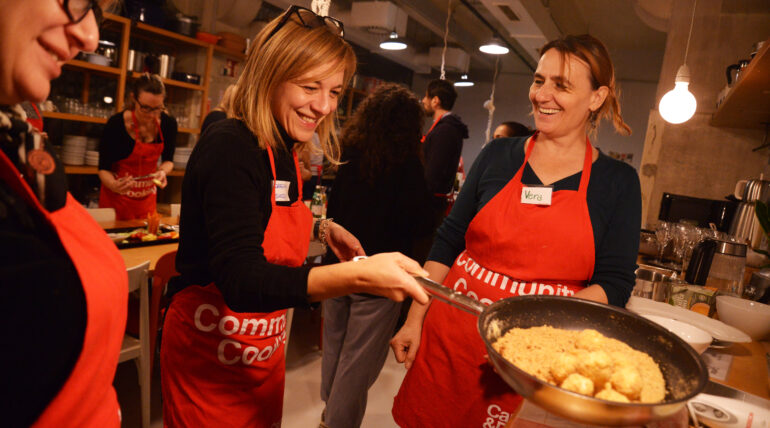
The present article is providing with a snapshot of the contextual aspects of food, culture and ethics in the emerging multicultural communities in the European countries, as they occur and the way that these communities could build upon cultural exchange and related integration measures and field awareness raising actions. This is serving as a piece of communication to facilitate awareness raising first among the local communities and those offering hosting, accommodation and social integration support services to migrants and refugees and also among the public authorities and the European societies at large.
This brief hereby starts with the developments in Greece and the response by the civil society, in a national environment where challenges related to the handling of significant numbers of refugee arrivals and to the cushioning of migrant population, are ever becoming more demanding.
Reflecting upon the Greek context
Nonetheless, the arrival of migrants during the last three decades – while picking up during the more recent 15 years – has significantly influenced the culinary atmosphere in Greece, diversifying local food offerings. In addition to traditional Greek dishes based on meat and seafood, the influence of migrant communities has introduced a variety of flavors and cooking methods to the Greek food scene. This is particularly evident in urban areas like Athens, Thessaloniki, Patras, Volos, Ioannina and Kavala, where local food offerings now include a wider variety of dishes from the Middle East, South Asia, and North Africa, such as falafel, shawarma, kebabs, and hummus!
The continuous arrivals of refugees, starting from the years of 2014/15 and the increase of migrant population is providing with the state-of-play for activating the civil society in Greece and for the launching of expanding field activities and awareness raining events, including those pursuing culinary arts and cooking multiculturalism.
To start with we should certainly refer to the UN High Commissioner for Refugees (UNHCR) initiative to organize annually the Cooking#WithRefugees Festival, with the support of civil society agencies and other actors, raising awareness about the needed help to the refugees to upgrade their skills, become empowered, gaining access to opportunities and, ultimately, entering the the labour market. With the occasion of the World Refugee Day, the Cooking (with Refugees) Festival returns to Athens, again this June 2025, to present culinary experiences and highlight the power of cultural exchange to facilitate social inclusion.
The World Refugee Day provides with an opportunity the European societies and of course the local communities in Greece and the Greek society at large to drive our attention to the refugees who happen to live with us, work alongside with us, struggle daily and gain hope through their work and social integration. And for this purpose, an invitation is extended to all aware citizens to participate to gatherings, honoring the Day and tasting what is being offered by the Greek and migrant as well as refugee “chefs”, who join forces in a number of restaurants to be named in the metropolitan area of Athens, sharing their inspiration from the cuisines of the Mediterranean cultures and of those from the Near East!
And in the meantime, tastes and aromas from Arabic, Middle Eastern and other extra-European third-country cuisines will be flavoring the spot in front of the Ancient Theater in the pedestrian Venizelou Street in Larissa. Where, residents and visitors and even migrants and refugees from the Larissa region will be sharing experiences on Wednesday, May 7, late afternoon, staring from 07:00 pm. This is happening in the frame of the Tastes of the World Festival, organized by the Municipality of Larissa, with the support of the Association of Thessalian Businesses & Industries and the local Public Employment Service (PES) office. It is supposed to come up with a festival of “original” tastes, the first of its kind in the region, with the support of the Office of the Deputy Mayor for Social Policy and the Migrant Integration Center (“KEM”).
The event is aiming at combining multiculturalism, flavors and traditions from the regions of the world, while the students of the local Apprenticeship Program of the Vocational (Cooking) Training Centre (“EPAS”) of the PES Office of Larissa will undertake the culinary work, boosted by professionalism and coupled by their passion to deliver. The broader aims of the festival are supposed to facilitate the cultural exchange and experiences between the local community and those refugees from third countries, fostering multiculturalism and serving solidarity, while strengthening social integration in the local community.
While Migration is keeping up
It is worth mentioning that such awareness raising activities at the local community level are taking place against a rather insecure environment regarding both the Eastern and the Southeastern frontiers of Europe. The prevailing conditions ask for intensive effort to be deployed in order to address increasing handling and integration needs for the refugees and migrants, especially in the frontier countries, but not only in them.
The full-scale war in Ukraine is triggering a major increase in humanitarian needs due the mass internal displacement within Ukraine as well as refugee outflows. The challenge is huge when we come to measure some 6,225,700 refugees from Ukraine were recorded across Europe, by the latest report of the UNHCR, with 6,167,100 registered for asylum, temporary protection or similar national protection schemes. As of the end of October 2024, 3.55 million people were displaced internally within Ukraine.
At the same time, as of October 2024, some 8,700 refugees and migrants arrived in Greece by land and sea. This amounted to a 6% increase compared to the previous month, and a 20% increase from October 2023. While, the Turkish authorities reported rescuing or intercepting 5,084 refugees and migrants at sea in October, 21% less than the previous month.
This picture for Greece comes in contrast to the broader one for the same period, regarding the total arrivals in Europe through the Mediterranean and Northwest African maritime routes, where we measure some 20,000 refugees and migrants. The latest arrivals were 13% lower than September, and 45% lower compared to October 2023. It proves that the arrivals to other EU frontier countries present significant decrease of these numbers from last year especially. In Italy for example the arrivals decreased by 26% compared to the previous month and 44% compared to October 2023. In Spain also, some 5,000 refugees and migrants arrived in October 2024 amounting to a 24% decrease compared to the previous month and a 72% decrease compared to October 2023.
As it regards the broader picture prevailing with the maritime routes ending in Southeastern European, as of October 2024, some 2,220 people arrived in, or transited through the subregion as part of mixed refugee and migrant movements. This resulted in 11% when compared to the previous month (2,000), but a 35% decrease compared to October 2023.
The figures present an unstable state-of-play regarding the EU frontier to the East and the South (especially the Mediterranean maritime routes) which is asking for the significance and the scope for increased awareness raising efforts by the local communities in the European countries, by deploying cultural exchange activities with culinary arts sessions and events, thus boosting effectiveness with handling refugee population and with social integration actions.
